
Retrofuturism
Retrofuturism (adjective retrofuturistic or retrofuture) is a trend in the creative arts showing the influence of depictions of the future produced in an earlier era. If "futurism is sometimes called a 'science' bent on anticipating what will come, retrofuturism is the remembering of that anticipation."
The word "retrofuturism" combines more recent ideas of nostalgia and retro with older traditions of futurism. An early use of the term was in the title of T.R. Hinchcliffe's Pelican book Retro-futurism - Penguin, 1967. A recent neologism, the actual term "retrofuturism" was used by American Lloyd Dunn in 1983, according to fringe art magazine Retrofuturism, which was published between 1988 and 1993.
Characteristics
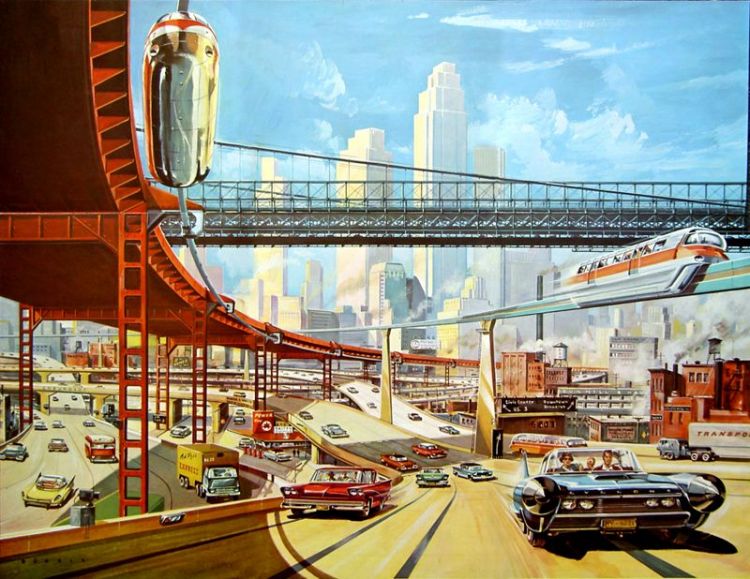
Retrofuturism incorporates two overlapping trends which may be summarized as the future as seen from the past and the past as seen from the future.
The first trend, retrofuturism proper, is directly inspired by the imagined future which existed in the minds of writers, artists, and filmmakers in the pre-1960 period who attempted to predict the future, either in serious projections of existing technology (e.g. in magazines like Science and Invention) or in science fiction novels and stories. Such futuristic visions are refurbished and updated for the present, and offer a nostalgic, counterfactual image of what the future might have been, but is not.
The second trend is the inverse of the first: futuristic retro. It starts with the retro appeal of old styles of art, clothing, mores, and then grafts modern or futuristic technologies onto it, creating a mélange of past, present, and future elements. Steampunk, a term applying both to the retrojection of futuristic technology into an alternative Victorian age, and the application of neo-Victorian styles to modern technology, is a highly successful version of this second trend. In the movie Space Station 76 (2014), mankind has reached the stars, but clothes, technology, furnitures and above all social taboos are purposely highly reminiscent of the mid-1970s.